A few weeks ago, I was invited by my brother to the Great Gatsby party at his apartment complex. I had to remind myself what the fashions were during the 1920’s, especially for those wild galas Fitzgerald wrote about. I searched my closet for some kind of ruffled skirt, a throw with fringe, some glitzy costume jewelry, and found a feather for a headband. My costume came together piece by piece, but when I stepped into the party surrounded by others in period costume, I was wholly in the role. I felt as though I were a flapper of a hundred years ago—relieved by the end of WWI and a return to better times, giddy with the expanded roles for women, and optimistic that more freedoms would follow. Hopeful for the future. In that garb, I felt somehow transformed, as if I were that newly liberated woman. I wished I’d been young then, as were my grandparents. It’s interesting how what we wear can so affect and reflect our self-image.
What we wear can be transformative. It can give us wings.
Thanks for reading As I Wander! Subscribe for free to receive new posts and support my work.
“Wings”
When I was about five, I came into a hand-me-down cowgirl skirt and bolero vest of crimson cotton with stitching that looped over the fabric like a lasso. Long white fringe dangled from the edges of the skirt and vest and, as I twirled, it brushed against my skin like feathers. When I slipped on that skirt and bolero, I was transported from my crowded home to a fantastic world of wild horses and cowgirl adventure. Sometimes I slept in my favorite outfit, and in my dreams I was a bareback-riding heroine, flying across exotic landscapes, equipped with superpowers to change my world.
I’m not a clotheshorse and have no experience in the fashion industry, but I am fascinated by the potential of an outer vestment to elicit both internal and external change. It can cloak the ordinary, the familiar, the flaws. It can create or reflect a new identity. A velvet jacket, silk wrap, sequined shirt, billowing cape can denote so many things: glamour, respect, sanctity, freedom, power, or possibility. Transformation via apparel is a recurring archetype across culture.
In the Wizard of Oz film, a click of Dorothy’s ruby slippers carries her home, her arduous quest to obtain them transformational. Harry Potter’s cloak confers the magic of invisibility, his secret weapon to take on the forces of evil. A fur-trimmed, red suit and white beard can transform anyone’s grandpa into an agent of magic. Cal Perkins’ “Blue Suede Shoes” song lyrics, in one origin version, were inspired by the words of an African-American, C.V. White, who in the early 1950s referred to his polished black Air Force regulation shoes, worn during leaves, as his “blue suede shoes” that no one was going to step on, no matter what other insults he might have to endure.
When my daughter was four, I bought her a faded blue dress with tiny white polka-dots at a Goodwill store. She loved it. One day, she asked me to help her find her dress.
“Which one are you looking for?” I asked.
“You know,” she said, “the blue princess dress that’s covered in diamonds.”
I didn’t have the heart to tell her that they were only white dots on faded cotton. When she put on that dress, she became a different girl—she sparkled. No wonder she wanted to wear it every day.
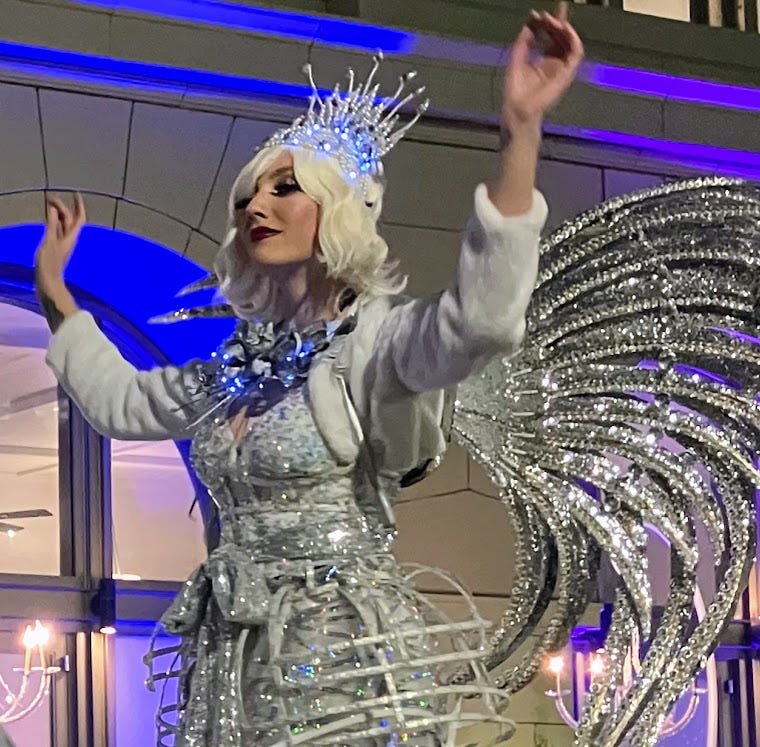
The role of clothing as mediums of transformation is reflected in folklore, too. In swan maiden stories from Turkey to Sweden, garments of swan feathers magically bestow the gift of flight, turning humans into birds or supernatural beings. Many such tales describe a swan-woman who is confined to an earthly marriage when a love-besotted hunter steals and hides her feathered garb. It is a disturbing tale of a clipping of wings, of freedom and autonomy stolen. Yet, the woman dreams of flight, and when she eventually finds her feathered cape and puts it on, she becomes a swan again and flies away—emancipation and reclamation of her natural self.
A Japanese version of the tale features a fisherman who also steals a girl’s robe of feathers while she bathes. When she begs him to return it, revealing that she is a celestial spirit and cannot fly without it, he is moved by compassion. He will give it back if she will promise to dance for him. She dons her wings, flies into the sky, performs a magnificent dance, like a kite in the wind, while singing the most beautiful and sensuous melodies he has ever heard, and then she disappears into the mist near the summit of Mt. Fuji. By allowing her liberty, they both experience transcendence.
In the 2014 article, “Dress, Body and Self: Research in the Social Psychology of Dress”, Johnson, Lennon, and Rudd (2014) summarize a number of studies that evidence that dress portrays social and cultural identity (both conscious and subconscious). How we choose to dress is based on shared symbolic values within a culture, often reflecting societal expectations. Our choices influence how we are perceived by others and affect the way we think about ourselves and how we perform in certain situations. This reminds me of a quote by Charles Horton Cooley, an American sociologist, that I first encountered in Psychology 101: “I am not who I think I am, I am not who you think I am, I am who I think you think I am.” Research with adolescents by Rhee and Johnson (2012) suggests that selections in dress reveal three identities: the social self (public persona),the actual self (internal self or soul) and the desired self.
These identities merge during religious or cultural rituals which mark transitions. A prayer shawl worn during a bar mitzvah, a white or pastel dress during a quinceaños, a pleated gown for a graduation. Shamans often wear regalia that call forth an animal—a bird, bear, or deer. During a healing ceremony, these entities may move into the body of the shaman, or the shaman travels to the dream realm of the spirits. In a Catholic mass, the celebrant dons vestments to cover his individuality and assume the role of priest performing a sacrament, in persona Christi, through which bread and wine become flesh and blood. Buddhist monks wear simple robes in shades of orange that represent purity of the soul, renunciation of the material life, and the quest for enlightenment.
When I see a group of adolescents dressed all in black, I interpret their attire as a sign that they are in mourning, grieving the loss of innocence and idealism, subconsciously dressed for the funeral of the child’s world they have left. When they have moved on from their grief, their garments will reflect this psychological change.
I am most interested in how clothing mirrors the desired self—how we would ideally like to be seen, who we dream to be. A necktie and buzz cut for a girl coming out, a flowered dress for a man in transition, worn overalls and boots for a young woman freshly impassioned with organic farming, a kilt or tie-dye attire for a man escaping an executive position, a purple cape for a woman embracing her seventy-fifth year. Dream your transformation, dress the part, practice your new life story, and live the change.
A time may come when you no longer need to dress the role. Your dream has become internalized and you don’t need an outer garment to show the world who you are. You have come into a new cadence with your soul, become confident, empowered by your change, truly yourself.
In time, I outgrew my fringed skirt and bolero and my dreams of bareback flights were replaced by others. Now, I have a creamy-white poncho hand-knit of soft undyed sheep’s wool by a wise montañera of Guerrero, Mexico. When I wear it and spread my arms, it expands and rises, as though I have wings. I feel lifted by the work of this woman’s hands, connected, and am inspired to reach out and do good in the world.
At the end of The Wizard of Oz, Dorothy learns that she had never needed the ruby slippers to go home. “You always had the power,” Glinda the good witch finally tells her. “You just had to learn it for yourself.” We discover that Dorothy’s odyssey was a dream but know that she has awakened transformed. Her world has shifted, and Kansas will never look the same to her again.
I realize that I don’t need my white poncho to imagine possibilities and make them real. But still, when I place it over my head and extend my arms, I feel closer to the person I want to be. On very cold nights, I sleep in it and in my dreams I can soar like a bird.
“Wings” was first published in Timberline Review 2023 Dream Issue 12
What I’m Reading:
The Great Gatsby by F. Scott Fitzgerald
I first read this in high school but decided that it’s time for a reread and I admit, I am approaching it from a completely different perspective and understanding than when I was seventeen years old. Written in 1925 and considered to be one the greatest American novels, it takes place in another gilded age (the post-war 1920’s.) The story of a millionaire and his obsessions, it explores themes such as the excesses of the rich, rampant materialism, corruption, the gulfs between the classes, and a callous indifference to the plight of the poor by the wealthy who are pulling the strings. I see certain parallels to what is transpiring now in our country. It’s an important time for a revisit of this American classic.
Creative Prompt:
In your writing or your art think about your external descriptions or depictions of your characters or subjects. How do these features reveal their interiority? Is their growth, redemption, or transformation revealed in the course of your work via a change in external detail?
Teresa H. Janssen writes prose and poetry. Her debut historical novel, The Ways of Water, was published November of 2023. The final chapters take place in San Francisco during the early 1920’s. Teresa is currently at work on a memoir about one extraordinary year of her life. More about her writing can be found online at https://www.teresahjanssen.com.
Thanks for reading As I Wander! Subscribe for free to receive new posts and support my work.
After a friend here in Port Townsend lost her husband last month, she went into the bank to deposit a large check. The clerk said, "Lucky woman! Did you sell your house?" She said, "No my husband died." She said to me after this incident that she wished our culture still wore black to symbolize mourning and the loss of a loved one so that this banker and everyone else would have an idea of what she was experiencing. Without this custom and the meaning behind it, she was sure she appeared to be the same as she was before instead of being seen as transformed.
I also thought of the women who wear the chador (a full length body cloak) and are hidden behind this garment in public. No need to get beautiful, to be judged, to be leered at or jeered at. They can walk hidden among the crowds and in that sense be free.



I didn't know the background to Blue Suede Shoes, that is really interesting!
Hi Teresa,
After a friend here in Port Townsend lost her husband last month, she went into the bank to deposit a large check. The clerk said, "Lucky woman! Did you sell your house?" She said, "No my husband died." She said to me after this incident that she wished our culture still wore black to symbolize mourning and the loss of a loved one so that this banker and everyone else would have an idea of what she was experiencing. Without this custom and the meaning behind it, she was sure she appeared to be the same as she was before instead of being seen as transformed.
I also thought of the women who wear the chador (a full length body cloak) and are hidden behind this garment in public. No need to get beautiful, to be judged, to be leered at or jeered at. They can walk hidden among the crowds and in that sense be free.
Thanks as always for your interesting essay.
Diane