

“Reading a Face”
POST #14 , November 30, 2025

I returned three weeks ago from a visit to Ireland. It wasn’t a typical tourist trip. I spent most of my time visiting friends and familiar sites in the counties of Donegal and Mayo in the northwest and on an island in county Galway. Whether chatting with a sheep farmer we ran into on a hike or studying an older fiddle player in a village pub, I was enthralled by the character in the faces I saw. I recalled the words of the late Irish writer and spiritual guide, John O’Donohue.
“...to gaze into the face of another is to gaze into the depth and entirety of his life.”
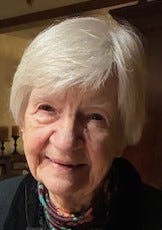
When I returned home, I went through photos of my deceased family elders. I saw them in a new way. Each wrinkle and scar, witness to the experiences of a life—the wrinkly face of my great grandmother ‘Cookie’, who spent most of her adult life in the northern wilds of early 20th century Alaska, the countenance of my grandpa Healy who loved to spin a tale or tell a joke, the edges of his eyes and mouth creased with permanent laugh lines. I looked more closely into the face of my still vibrant 96-year-old mother, her visage now a beautiful reflection of wisdom and compassion gained from the peaks and valleys of her life.
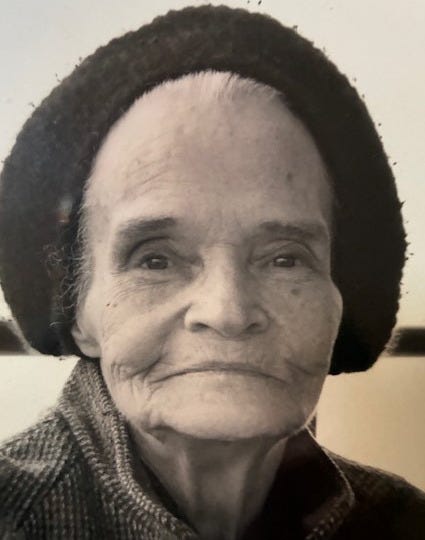
When I was writing my historical novel based on the young life of Josie, my paternal grandmother, I kept the image of her face in my mind. I knew my grandma best when she was in her later years, when much of her life experience was already reflected there.
If you were to have seen my grandmother walking down a sidewalk of Seattle’s Queen Anne neighborhood during the 1970’s, you might glance at the slightly overweight, gray-haired, conservatively-dressed woman, and then move on to look at a billboard or shop window. Large black purse in one hand, shopping bag in the other, she would be disregarded, as so many older women are.
If you were to look more closely, you would see the sparkle in her hazel eyes. You might notice the cross-hatch of wrinkles across her cheeks and mouth, as fine as spider web, the sag of a cheek, and perhaps the thin white scar on the cleft of her chin. Her face bears the marks of a long life, traumatic at times, yet filled with small joys—a life that may not have turned out the way she’d once hoped. She’s a survivor.
One of my favorite deejays, Dalana, at our Port Townsend radio station, ends her Saturday afternoon program each week by reminding her listeners to be kind to everyone they meet. Many carry burdens we cannot see.
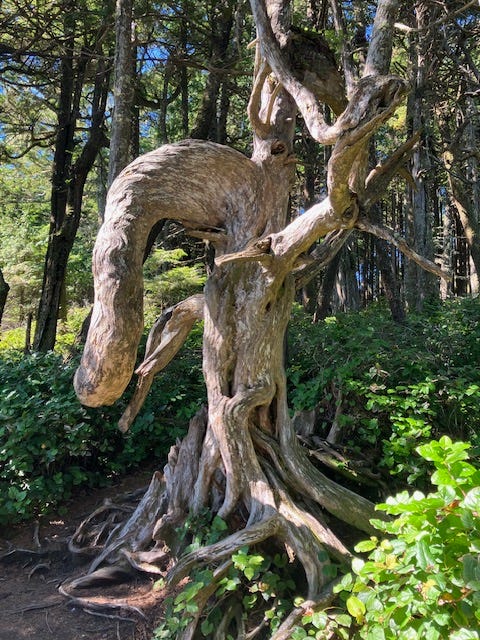
I think about that when I hike the woods near home. I admire the incredibly straight trunks of the Doug firs that abound. But what interest me more are the cedar, wild cherry, madrona, fir and big-leaf maple whose forms tell stories. Trunks split near the base, deformed by extreme weather (wind, flood, drought) or environmental injury—fire or pollution. Bark scarred by a chainsaw, pocked by bird excavations or insect infestation, mottled by fungi. Branches that crook, like bent elbows. Most fascinating are the burls that bulge from the trunk or roots, like warty lumps. The benign growths form when a tree is stressed. The burl seals off the wound, like a scar, in the tree’s effort to save itself. The bark of a tree communicates its history, its struggles and triumphs, just as a weathered face has much to say about a life.
If you were to have engaged my eighty-year-old grandmother in conversation, you would have realized that she has many stories to tell. Her eyes come alive, but you begin to understand the reasons for her care-worn visage. It was listening to these stories that prompted me to want to write about her itinerant and tumultuous girlhood in the Southwest during one of the most turbulent periods of American history. But all people and natural things undergo stress and pain. It’s part of living.
John O’Donohue writes in his book Beauty an entire chapter on the beauty of the flaw. He cites the concepts of wabi in Japanese culture in which the presence of a flaw deepens the character and beauty of an object, and shibui, which refers to the beauty of ageing. O’Donohue describes how in those we love, the days and years enrich their faces “with ever new textures of presence.” Each human face is a landscape that is “quietly vibrant with the invisible textures of memory, story, dream, need, want, and gift.” Beyond personality and fashion, it’s the soul that makes the face beautiful.
Trees with burls are highly valued. It can take as long as thirty or forty years for a burl to grow to its full size. The pattern and grain of burled wood is irregular and more intricate than ordinary wood and is more expensive because of its beauty and scarcity. Unfortunately, burl poachers will sometimes use chainsaws to cut a burl off of a tree. This can wound the tree and sometimes kill it.
Most woundedness remains hidden, lost inside forgotten silence, O’Donohue tells us, and some wounds continue to weep secretly, even after years of attempted healing. I waited until after my grandmother’s death to begin writing about her life, based on the notes I’d taken and photographs saved. I realized in the process that there were details missing, gaps and inconsistencies in her accounts, and that I’d neglected to ask her important questions. But I inherently knew that I should not probe too deeply or damage the scars that had formed to protect her and help her survive. O’Donohue reminds me that “no life is without its broken, empty places”, but “where woundedness can be transformed into beauty, a wonderful transfiguration takes place.”
The Ways of Water: A Novel was inspired by my grandmother’s early life in the Southwest.
Parts of the above content were previously published in a Northwest Book Lovers, Northwest Voices essay (Nov. 2023), entitled “Beautiful Flaws”.
What I’m Reading:
44 Irish Short Stories: An Anthology of Irish short Fiction from Yeats to Frank O’Connor. Edited by Devin A. Garrity ((Konecky & Konecky 1955)
Yes, the Irish have a way with words which often brings, as in this collection, pure magic. These stories combine lyrical language with humor and tragedy. But it’s the people that inhabit these short spare tales that have disarmed me. Often ‘naïve’ country folks reveal depth and sophistication that turn the tables. As I read I try to envision their faces, and always they’re alive with texture and personality.
Creative Prompt:
Visit an older friend or relative, go to a public place, or ride a bus. Study the faces around you. Try to see, as O’ Donohue wrote, the vibrant landscape, the “textures of presence”.
Or take a walk in a wild, exposed, or windy place and notice the stunning ‘imperfections’ of nature.
Write, compose, paint or sculpt the feelings, insights, or wonder they impart.
I love your thoughts of elder faces and trees with burls. My wrinkles and spots have begun taking me over. :) Wish I could have visited this past summer, but an arthritic back has interfered with my getting around—now use two poles for my walks. Getting old requires some kind of courage and a sense of humor as I expect your grandmother was well aware!